

Stadium LED displays are modular, full color LED systems specifically designed for various sports venues. Serving as a core facility for modern stadiums, they support functions such as displaying event information, broadcasting live footage, showing slow motion replays, presenting commercial advertisements, and enhancing the atmosphere. They are widely used in soccer fields, track and field arenas, basketball halls, and multi purpose spots complex.
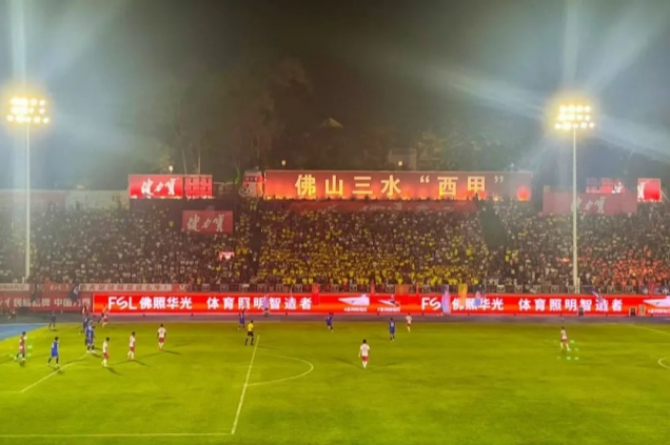
I.Main Types of Stadium LED:
(1)Court side perimeter LED display:
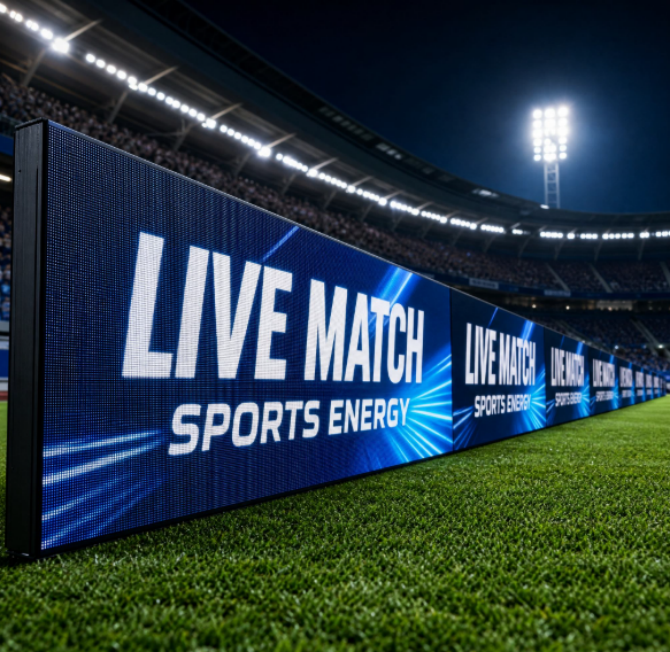
This is the most common type, installed around the perimeter of the competition field. The cabinets are typically made of die cast aluminum and feature a soft, impact absorbing face cover to prevent athlete injuries from collisions. They support both permanent installation and rapid assembly rental setups. Widely used in soccer stadiums and track and field venues, they commonly feature pixel pitched of P6.67, P8, and P10.
(2)Dou style screen:
Typically used in indoor basketball arenas, these are suspended overhead and usually feature a four sided or six sided structure offering 360 degree visibility, allowing spectators throughout the venue to easily view scores and replays, high definition specifications such as P2.5, P3, and P4 are commonly used.
(3)Main large format scoreboard:
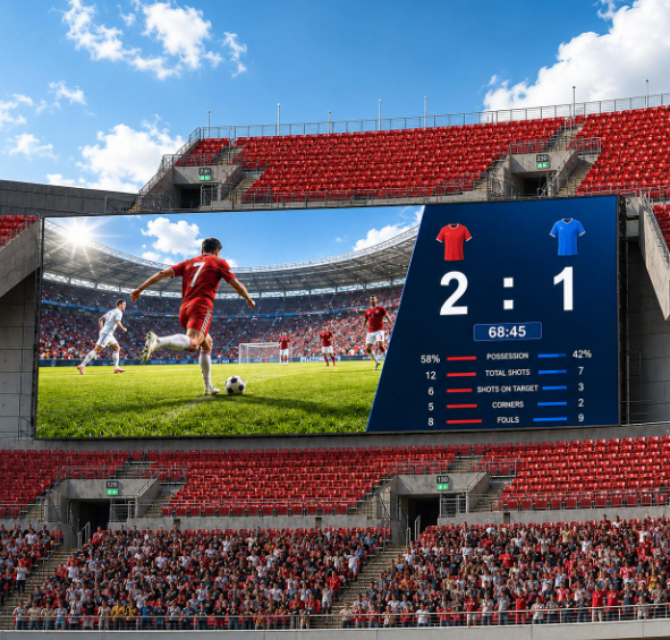
Installed at the high points at both ends of the stands, these serve as the venue’s core large scale displays. Featuring large dimensions and partially curved designs, they handle key functions such as live event broadcasting, replays of critical moments, and the display of aggregate scores and timing.
(4)Ring shaped/Ribbon style screen:
The elongated screens installed along the eaves of the upper tier stands primarily display scrolling advertisements and text slogans, enhancing the overall atmosphere of the arena.
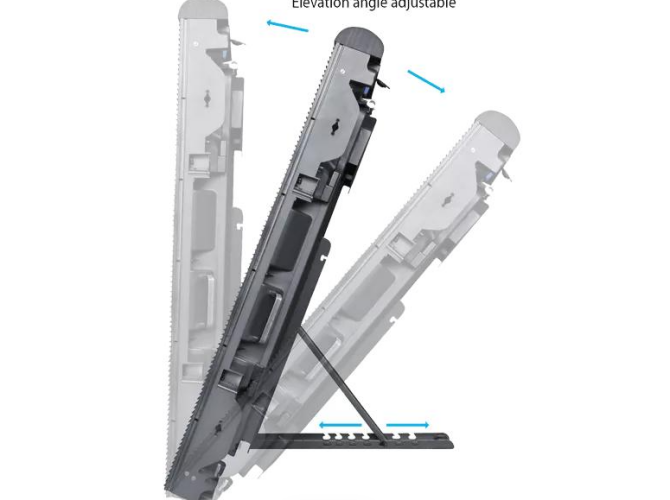
II.Key features of Stadium LED:
①High Refresh Rate: professional grade display with a refresh rate of ≥3840Hz, ensure flicker free and ripple free footage when filmed by cameras, meeting the requirements for live television broadcasting.
②High Brightness: outdoor screens feature a brightness of 6000 to 10000cd/m², ensuring clear images in strong light, indoor screens range from 1200 to 2000cd/m².
③Reliable Protection: the outdoor model features standard IP65 water and dusty resistance, capable of withstanding sun exposure heavy rain, and temperature fluctuations, the perimeter display incorporates enhanced impact resistant design.
④High Gray scale: ≥16 bit gray scale, uniform color, excellent image gradation, and no visible color banding.
⑤Stable and Controllable: supports synchronous control systems and integrates with referee consoles and professional timing/scoring units to automatically synchronize event date, simultaneously supports asynchronous offline advertising playback and offers partial signal hot backup capabilities to ensure the display remains active throughout the event.
III.Key functions of Stadium LED:
①Match date: real time display of scores, countdowns, fouls, player information, and match statistics.
②Live streaming and replays: rental time broadcast of match action, with slow motion replays of goals and controversial moments.
③Commercial operations: rolling broadcasts of sponsor advertisements serve as a key revenue generating channel for the stadium.
④Atmosphere creation: opening special effects, warm up video, interactive graphics, and slogan displays.
⑤Multi functional versatility: the screen can serve as the main display when the venue hosts concerts, sporting events, or large scale gatherings.
IV.Supporting systems:
Includes LED display cabinets, receiving/sending cards, video processor, professional sports timing and scoring software, and fiber optic transmission equipment, capable of integration with audio and lighting systems.
VI.Roughly how much LED display screen is needed for a football field?
(1)Perimeter LED boards(core component, essential for the league):
Standard height 0.96m(standard cabinet height of 960mm)
①Basic version(two long sides only, not installed behind the goals)total length about 210m to 200m².
②Standard full cabinet(installed on all four sides, for amateur county level competitions)total length about 260m to 250m².
③Professional full perimeter cabinet(official FA leagues, professional stadiums)total length about 260 to 280m to 250 to 270m².
(2)Main scoreboard screen on the grandstand(one end/both ends):
①Single main large screen for small to medium sized stadiums: 40 to 80m².
②One section at each end of the high standard court: 80 to 150m² in total.
(3)Complete set total(fencing + main large screen):
①Standard court(250m² fencing + 60m² main large screen)approx 310m².
②Basic court(fencing only 200m², no standalone main large screen)200m².
③Professional high standard court(fencing 270m² + dual main large screens 120m²)nearly 400m².
(4)Reference for 7 a side and 6 a side small sided pitches:
①7 a side: perimeter boards/ screens typically 60 to 100m².
②5 a side: perimeter fencing/screen typically 30 to 60m².
 English
  简体中文
简体中文  Português do Brasil
  Italiano
  Español
  Français
  Deutsch
  한국어
한국어  日本語
日本語