

一.LED Screen (Large format video walls, outdoor advertising screens):
Each pixel is an LED, the pixels are self illuminating powered on to light up and powered off to turn dark.
①When not emitting light, it’s pure black, resulting in extremely high contrast.
②Capable of creating ultra large video walls with high outdoor brightness.
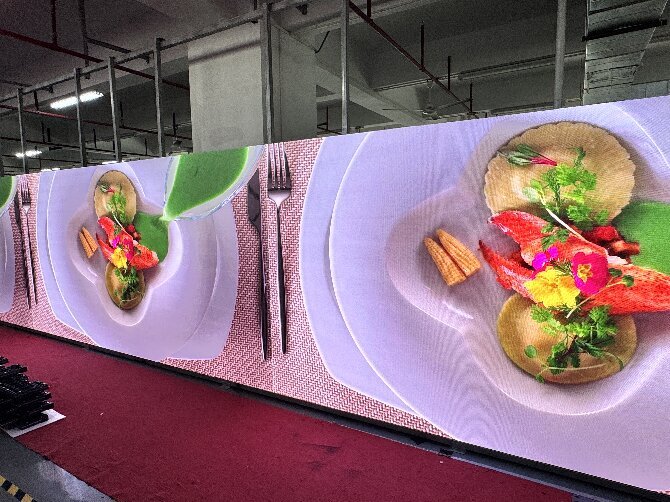
二.LCD Screen(monitor, standard TV, laptop screen):
Liquid crystals do not emit light themselves, there is a back light panel behind them, and the rotation of the liquid crystal molecules controls whether light passes through.
①Black is achieved by blocking the back light with the LCD layer, true, pure black is impossible to attain, and light leakage occurs.
②The panel is a single, continuous piece, manufacturing it in large sizes entails high costs.

三.Strengths and weaknesses of LED and LCD Screens:
(1)The strengths of LED Screens:
①High brightness, suitable for outdoor screens, clearly visible in strong light.
②High contrast, when LED turn off, the result is pure black, delivering a rich sense of depth and layering in the image.
③Supports seamless, infinite tiling to create massive screens spanning tens or even hundreds of square meters, the COB process renders seams virtually invisible.
④It offers a wide viewing angle, allowing for clear visibility from steep angles, both horizontally and vertically, with minimal degradation in brightness or color.
⑤Flexible in form, capable of creating curved or irregularly shaped screens, and easy to assemble and disassemble for stage rentals.
(2)The weaknesses of LED Screens:
①Pixel pitch determines clarity, close range viewing requires a fine pitch, which entails higher cost, whereas a large pitch results in a visible dot pattern when viewed up close.
②Overall power consumption is relatively high, electricity costs are significant when used extensively.
③There is a risk of dead LED pixels, requiring subsequent maintenance.
④The resolution of an individual cabinet is not high, and text detail is inferior to that of an LCD display of the same size.
⑤It can easily cause glare in low light indoor environments.
(3)The strengths of LCD Screens:
①Fine pixel detail and high native resolution on a single screen ensure crisp rendering of text, tables, and images, offering an excellent viewing experience at close range.
②Lower power consumption for the same surface area, save energy for home and office use.
③The color is uniform and stable, free from graininess, and the price is affordable.
④The unit is mature and reliable, with a low failure rate and virtually no need for routine maintenance.
(4)The weaknesses of LCD Screens:
①It cannot emit light on its own and relies on a back light, black areas of the image suffer from light leakage, appearing dark gray rather than true black and contrast is limited.
②The tiled setup has visible seams between the physical bezels, making it difficult to achieve a truly seamless look.
③Limited brightness, not suitable for outdoor environments with strong light.
④Viewing from wide angles results in darkening and color shift.
⑤There is a limit to the maximum size of a single screen, ultra large screens can only be created by tiling multiple units.
四.The function of LED and LCD Screens:
(1)Function of LED Screens:
Enables the display of massive images suitable for long distance viewing by large audiences, can be used both indoors and outdoors.
①Outdoor advertising: roadside billboards and shopping mall facades, remains clear even in bright light, display videos, posters, and promotional films.
②Conference room/Command center: large scale video wall displaying surveillance feeds, data charts, and meeting presentations.
③Stage and Event rental: concert and event backdrop screens, available in curved or custom shapes, and easy to assemble and disassemble.
④Retail and Showroom displays: storefront signage screens and showroom backdrops for playing marketing videos and promotional content to drive traffic.
⑤Traffic information: highway signage and station information displays provide notifications and traffic condition updates.
(2)Function of LCD Screens:
Designed for detailed, close range viewing, primarily utilizing a single screen setup, commonly used in office and indoor home environments.
①Office displays: computer monitors for handling documents, spreadsheets, and design work.
②Home entertainment: home TVs for watching movies and series.
③Large indoor surveillance display: security monitoring room featuring a multi screen video wall for viewing surveillance footage.
④Commercial terminals: front desk displays, ordering kiosks, information kiosks, elevator advertising displays.
⑤Teaching equipment: all in one teaching machine, instruction via course ware presentation.

 English
  简体中文
简体中文  Português do Brasil
  Italiano
  Español
  Français
  Deutsch
  한국어
한국어  日本語
日本語