

1) Para painéis de LED de 1920Hz:
①A imagem é geralmente nítida, mas podem ocorrer ligeiros efeitos fantasmas ou desfoque ao exibir cenas com movimentos rápidos.
②Ao filmar com um celular ou filmadora, é mais provável que apareçam ondulações na água, padrões de moiré e listras tremeluzentes.
③Embora o nível de conforto visual seja suficiente para as necessidades diárias de visualização, a visualização prolongada ou a exposição a imagens que mudam rapidamente pode causar fadiga ocular com mais facilidade.
④O princípio técnico normalmente emprega um circuito integrado de acionamento de trava dupla, que é relativamente barato e oferece alta relação custo-benefício.
⑤ Principais cenários de aplicação: ocasiões gerais de exibição, como reuniões internas regulares, disseminação de informações, salas de aula e shoppings, onde não há requisitos especiais para filmagem.
2) Para painéis de LED de 3840Hz:
①O efeito de exibição é mais estável, nítido e suave em cenas dinâmicas, capturando com precisão os detalhes de objetos em movimento rápido.
②O efeito de disparo evita eficazmente ondulações e oscilações na água durante a captura, resultando em imagens mais limpas e claras.
③Uma taxa de atualização mais alta ajuda a reduzir o cansaço visual durante a visualização prolongada, tornando a experiência mais confortável.
④ O princípio técnico exige o uso de um circuito integrado de driver PWM de alta definição e alta ordem, como a solução FT7780, que é significativamente mais cara devido à sua complexidade.
⑤Principais cenários de aplicação: apresentações ao vivo, transmissões esportivas, publicidade comercial de alta qualidade, filmagens virtuais em realidade estendida (XR) e ocasiões que exigem filmagens com equipamentos profissionais.
3) Características do painel de LED de 1920Hz:
①Sua fluidez supera em muito as taxas de atualização convencionais anteriores, como 960Hz e abaixo de 1920Hz; para o olho humano, a visualização da maioria dos conteúdos dinâmicos, como vídeos e animações em PowerPoint, já é muito fluida.
②Sem usar uma câmera para capturar as imagens, o espectador médio praticamente não teria como perceber a diferença na fluidez em comparação com taxas de atualização mais altas, como 3840Hz.
③Com tecnologia consolidada e uma cadeia produtiva completa, atualmente é a opção mais popular e com melhor custo-benefício do mercado, alcançando o equilíbrio ideal entre atender aos requisitos básicos de exibição e controlar o orçamento.
④ Adequado para a maioria das ocasiões que não exigem fotografia profissional, como: salas de conferência internas, salas de aula, telas de informação em shoppings, a maioria das telas de publicidade externa, centros de monitoramento de dados, etc.
⑤Sua maior característica, e também sua limitação, é que não consegue lidar perfeitamente com todos os dispositivos de câmera. Com obturadores eletrônicos de celulares e filmadoras, é propenso a produzir linhas de varredura onduladas e oscilações, tornando-o inadequado para situações que exigem gravação ou transmissão ao vivo.
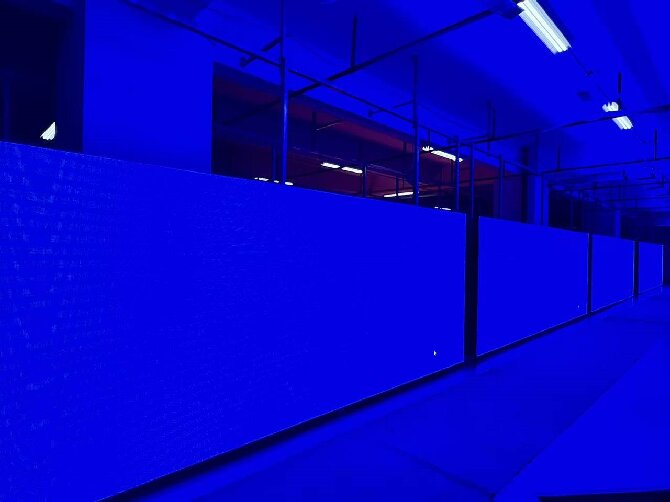
4) Características do painel de LED para videowall de 3840Hz:
①Esta é a sua característica mais importante e insubstituível: ela pode eliminar quase completamente as ondulações e oscilações na água sob diferentes velocidades de obturador de câmeras e celulares, garantindo imagens nítidas e estáveis. É por isso que emissoras de televisão, produções cinematográficas e televisivas e transmissões ao vivo em larga escala devem adotar esse padrão.
②Atingir uma alta taxa de atualização de 3840Hz não é simplesmente uma questão de aumentar os parâmetros; depende de circuitos integrados de driver PWM de alta qualidade, como as séries Macroblock MBI e Chipone ICND, e algoritmos de varredura mais complexos, representando um nível mais elevado de tecnologia e estabilidade.
③Embora o olho humano perceba apenas uma melhoria limitada na suavidade acima de 1920Hz, 3840Hz teoricamente proporciona bordas de imagem mais estáveis e nítidas, além de reduzir fantasmas extremamente sutis ao exibir cenas de movimento muito rápido, como replays em câmera lenta de corridas de carros ou jogos esportivos.
④Devido aos seus custos tecnológicos e ao seu posicionamento central como um serviço de filmagem, é utilizado principalmente em cenários sofisticados com necessidades de filmagem rigorosas ou orçamentos suficientes, como estúdios de transmissão e televisão, cenários de palco para concertos ou galas, telas principais de eventos de e-sports, lançamentos de marcas de luxo e estúdios de filmagem virtuais de XR.
5) Como escolher um painel de LED para videowall de 1920Hz ou 3840Hz de acordo com as características do local:
① Optar por 1920Hz se a sua tela for usada principalmente para visualização humana e não for fotografada com frequência, como em salas de conferência corporativas, showrooms, telas de informação em shoppings e na maioria das telas de publicidade internas e externas, é uma escolha perfeitamente adequada e econômica.
②Escolha 3840Hz se a sua tela for usada para filmagens ou transmissões ao vivo por meio de celulares, câmeras ou outros dispositivos, ou se você tiver requisitos extremamente altos de qualidade de imagem dinâmica, como em estúdios de TV, shows, eventos de e-sports ou lançamentos de produtos de ponta. Nesse caso, você deve escolher um produto com taxa de atualização de 3840Hz ou superior para evitar ondulações na imagem e garantir a qualidade da filmagem.
 Português do Brasil
  English
  简体中文
简体中文  Italiano
  Español
  Français
  Deutsch
  한국어
한국어  日本語
日本語