

Key differences between Copper and Iron lead frames for indoor LED modules:
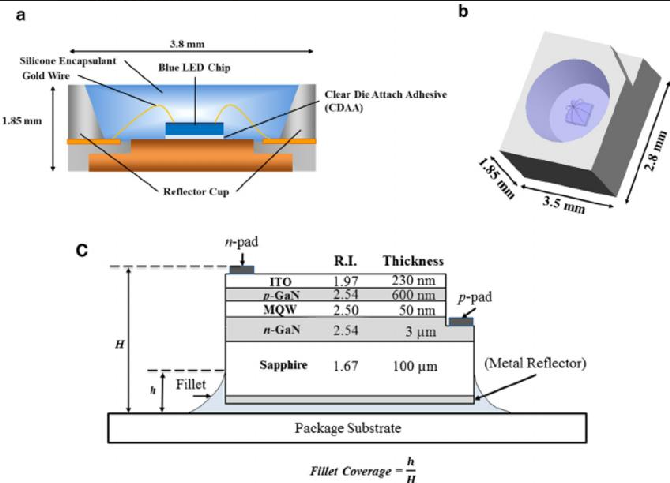
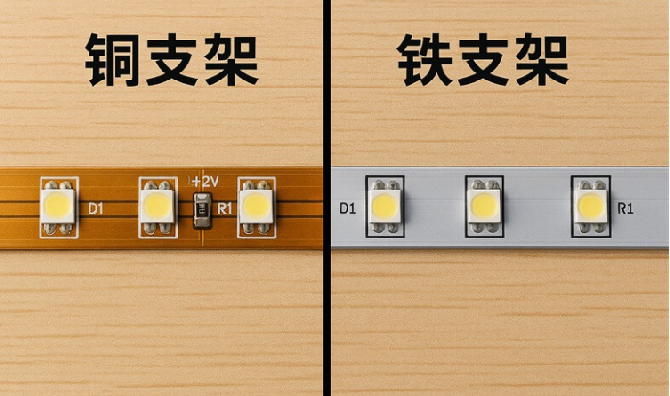
This refers to the internal metal lead frame(silver plated)of the LED package, not the sheet metal housing of the module.
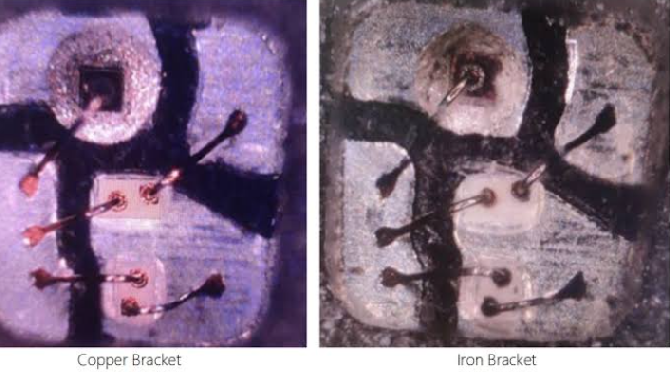
I.Comparison of basic performance:
(1)Heat conduction and dissipation (most critical)
①Copper lead frame: thermal conductivity=401W/mK, rapid heat dissipation, low LED junction temperature, and slow light decay.
②Iron lead frame: Thermal conductivity=80W/mK, poor heat dissipation leads to heat accumulation in the chip, resulting in significantly faster light decay.
(2)Electrical conductivity:
①Copper: low resistivity and uniform current flow, resulting in better brightness consistency across the entire screen.
②Iron: its resistivity is approximately 5.8 times that of copper, long term use tends to result in uneven voltage drops, localized dimming, and flickering.
(3)Corrosion resistant / Oxidation resistant:
①Copper: offers superior stability, less prone to oxidation or blackening in humid indoor environments.
②Iron: the base material is prone to rusting, once the silver plating is damaged, it oxidizes rapidly, leading to dead LEDs, cold solder joints, and black spots.
(4)Reliability regarding thermal expansion and contraction:
①Copper offers excellent ductility, minimizing the risk of open circuits at solder joints caused by the thermal shock of repeated power cycling.
②Iron is relatively brittle, prolonged exposure to alternating hot and cold temperatures makes it prone to solder joint failure and gold wire breakage, resulting in a high failure rate over time.
(5)Service life(standard indoor use):
①Copper bracket: standard 3 to 5 year warranty, usable for 5 to 8 years.
②Iron bracket: most come with a 1 to 2 tear warranty, but widespread significant lumen depreciation and LED failures typically begin after 2 to 3 years.
(6)Cost price:
①Copper lead frame LED lamps: high cost, with the overall module price 15% to 30% higher.
②Iron bracket LED lamps: extremely low cost, mostly used in low cost projects and temporary screens.
II.Application scenarios(indoor screen selection):
(1)Premium copper bracket series: fine pitch(P1.25 / P1.53 / P1.86 / P2)displays for conference rooms, showrooms, and reception areas, large scale commercial fixed displays requiring stable operation for over 3 years and minimal after sales service.
(2)Optional iron framework: suitable for short term event rental screens, temporary hoarding advertisements, ultra low budget projects, and installations intended for replacement after just 1 to 2 years.
III.Simple identification methods(practical for inspecting goods):
Magnet test method: remove the module mask and bring a magnet close to the LED pin.
①Won’t stick → Copper bracket.
②Can be firmly attached → Iron bracket(Iron substrate is magnetic)
IV.Hidden pitfalls often overlooked by Novice Customers: Copper / Iron brackets:
Many clients compare only pixel pitch and price, completely overlooking the LED bead and bracket specifications, it’s only later, when widespread dead pixel and light degradation occur that they realize they made a mistake.
(1)Easily overlooked during the selection phase:
For P1.86 / P2 modules of the same specification, there is a significant price gap, largely due to the difference between copper and iron brackets. Novices often assume the price difference is simply down to the manufacturer, unaware that the lifespan of the copper bracket version is more than double that of the iron bracket one.
Risk:purchasing a low priced iron bracket unit with the expectation of 3 to 5 years of stable use, only to experience back light failure or screen artifacts after just two years.
(2)Wasn’t aware that iron brackets are suitable for short term use but not for the long term:
Right after installation and for the first year, the image quality looks virtually flawless, passing initial inspection without issue. However, when a cluster of problems arises in the second year, one might mistakenly conclude that the product’s overall quality is poor.
(3)Unable to distinguish between the internal lead frame of the LED chip and the metal housing of the module:
Many clients mistake this for the module’s iron or copper back plate, whereas it actually refers to the internal lead frame of the LED package, this often leads to misunderstandings during communication.
 Français
  English
  简体中文
简体中文  Português do Brasil
  Italiano
  Español
  Deutsch
  한국어
한국어  日本語
日本語