

I.Core assessment(Outdoor):
If the screen is mounted flush against a wall or building facade, with no access aisle behind it and no possibility of installing a rear maintenance platform, choose an outdoor front maintenance LED display:
(1)Tasks suitable for outdoor pre-maintenance:
①Exterior walls of commercial premises storefront signage/displays(most common):
Exterior signage for street front shops or chain store outlets, mounted directly onto a brick wall or the building’s exterior, there is o access for maintenance from behind or from inside the premises. These installations are typically small in size(mostly ranging from 2 to 15 square meters)
②Wall mounted screens for building exteriors, small advertising screens for building facades:
For installations directly on the exterior walls of office buildings, hotels, or residential complexes, it is not possible to create access openings in the wall, and there no space for maintenance work from behind, in many cases, these involve vertical, narrow format information displays.
③Smart LED pole displays, small sized information displays for poles:
Outdoor screens mounted on LED poles or single post structures for rear access, consequently, they almost exclusively utilize front serviceable, magnetically attached modules.
④Column wrap outdoor screens, custom shaped curved outdoor screens:
Wrap around LED displays for outdoor cylindrical or square columns, featuring a curved exterior, the rear side is obstructed by the column, making rear maintenance impossible.
⑤Irregularly shaped displays, cube displays, cylindrical displays, and column wrap displays:
Curved surfaces, column wrapped displays, and cube shaped configurations, there is simply no access from the rear, making front side maintenance the only viable option.
⑥Selected rental screens:
When the stage backdrop is positioned flush against a wall or a fixed truss, leaving no room for access from behind, front maintenance cabinets are the preferred choice.
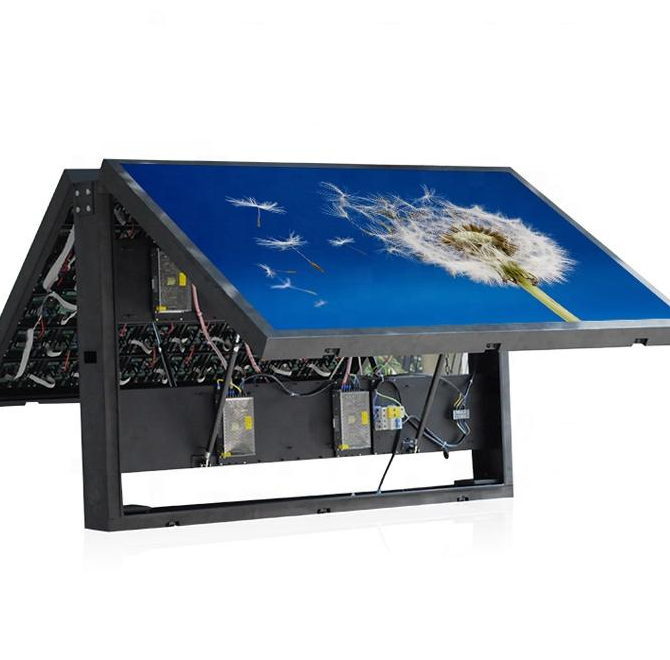
II.The features of front maintenance LED:
Modules, power supplies, and receiving cards can be accessed and removed from the front.
①No rear access space is required, the screen can be mounted flush against a wall or recessed. Since there is no need to reserve a 60-80cm maintenance corridor, it saves space and is ideal for applications such as storefront windows, building facades, column cladding, and elevator lobbies.
②The installation is aesthetically pleasing, it can be made ultra slim and flush with the wall, with no protruding rear maintenance frame, an ideal solution for showrooms, conference rooms, and reception areas.
③Fast maintenance, operable by a single person, modules can be removed using a suction tool, allowing for direct replacement of modules, power supply units, or receiving cards, minimizing downtime.
④Highly adaptable to various shapes, including cylindrical, curved, and custom contoured displays, as well as screens embedded in glass curtain walls.
⑤Civil engineering and structural costs are low, there is no need for rear maintenance platforms, access doors, or steel structure walkways, which often results in saving on civil construction expenses.
III.What other factors should be considered when choosing front maintenance displays?
(1)Structure & Installation conditions:
①Front maintenance is only suitable when there is no access aisle behind the unit and it’s mounted flush against a wall pr steel structure. If there is space behind the unit, rear maintenance is more cost effective.
②The front maintenance cabinet features magnetic catches or locking latches, allowing the panel to swing outward.
③Options include magnetic closures, spring loaded pop open mechanisms, and latches. For outdoor use, prioritize versions with latches that feature waterproof sealing strips.
(2)Waterproofing(crucial for outdoors)
①Sealing techniques, such as the use of gaskets and the sealing of joint are applied between the cabinet, the area the front maintenance opening door is particularly prone to water leakage.
②Water drainage channels inside the cabinet, no water accumulation allowed.
③Confirm an IP65 rating, many low cost front maintenance outdoor screens fail to meet this waterproofing standard.
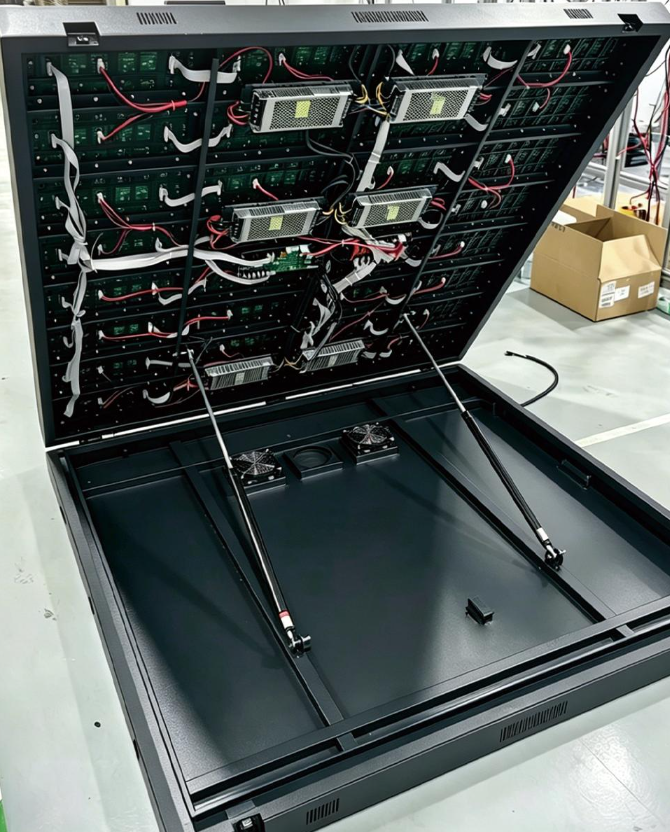
(3)Maintenance operations:
①Single module maintenance is more flexible, but the structure is more expensive, flipping up the entire panel is cheap, but flipping it off completely for repairs is heavier.
②Front maintenance generally does not require rear access doors, however, provisions must be made for module handles and unlocking tools.
③Sufficient operating space must be left in front of the screen, it should not be positioned directly against a road or any obstacles, as workers need to be able to reach the modules from the front to remove or install them.
(4)Cost:
①Modules for front maintenance cabinets are expensive, resulting in a higher unit price compared to standard rear maintenance cabinets.
②Stock is maintained for front maintenance specific modules, latches, and gaskets, replacement parts are priced higher.
③For maintenance work performed at heights from the front side, the labor costs can sometimes be even higher.
 日本語
 English
 简体中文
 Português do Brasil
 Italiano
 Español
 Français
 Deutsch
 한국어